



Imagine two new employees are given the same project. The first asks, “What exactly would you like me to do next?” The second asks, “What outcome are we trying to create?”
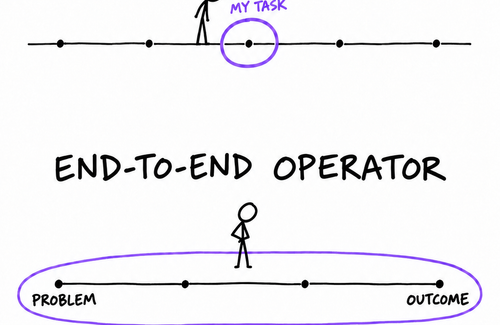
Wes Kao calls the second person an end-to-end operator. They don’t have to be told exactly what to do. Instead, they investigate the problem, act like an owner, switch between strategy and execution, think ahead, cross-train and develop skills in adjacent areas and translate vision into reality.
Who doesn’t want to hire someone like that?
Wes argues that the end-to-end operator is becoming increasingly valuable.
Unfortunately, most people aren’t thinking about their career through the lens of an end-to-end operator. Many are stuck as “siloed operators” or “task executors.”
It’s hard to have impact, develop new skills and enjoy your work when you are a “siloed operator” or “task executor.”
It’s not surprising that people end up working this way. Look at what got them here: most career thinking is still organized around job titles. We help people identify:
-an occupation
-the tasks it involves
-which qualifications they need.
When the job title is the starting point, it also teaches people to focus only on their assigned part of the work. (This can lead to less understanding, less learning, and worse results).
End-to-end operators have a different approach. They start with a problem to solve, and then they define the outcome they want to create. Seeing the bigger picture like this helps them figure out what needs to happen, including what they can do, what they need to learn and who they need to involve.
Consider a student who cares about helping people feel less lonely.
Option A: Begin with job titles. They might explore becoming a psychologist, social worker or community outreach coordinator.
Option B: Begin with a challenge to solve. They have to investigate it more broadly and more deeply. Why are people lonely? Who is most affected? What has already been tried? What seems to be missing? What could I contribute?
They might interview people, study psychology, organize an event, create a campaign, prototype an app or evaluate whether an intervention worked. They are now moving across research, communication, technology, design and community development.
Option B helps the student see what's really needed, rather than the small part assigned to one profession. They develop the ownership, adaptability and resourcefulness to bring an idea to life.
Yes, we eventually need people to explore jobs, programs and qualifications. And yes, tasks. But they shouldn’t start there.
Instead, we should help them develop the mindset of an end-to-end operator: someone who can take something from a vague problem to a useful outcome. That may be some of the best career preparation we can give them.


